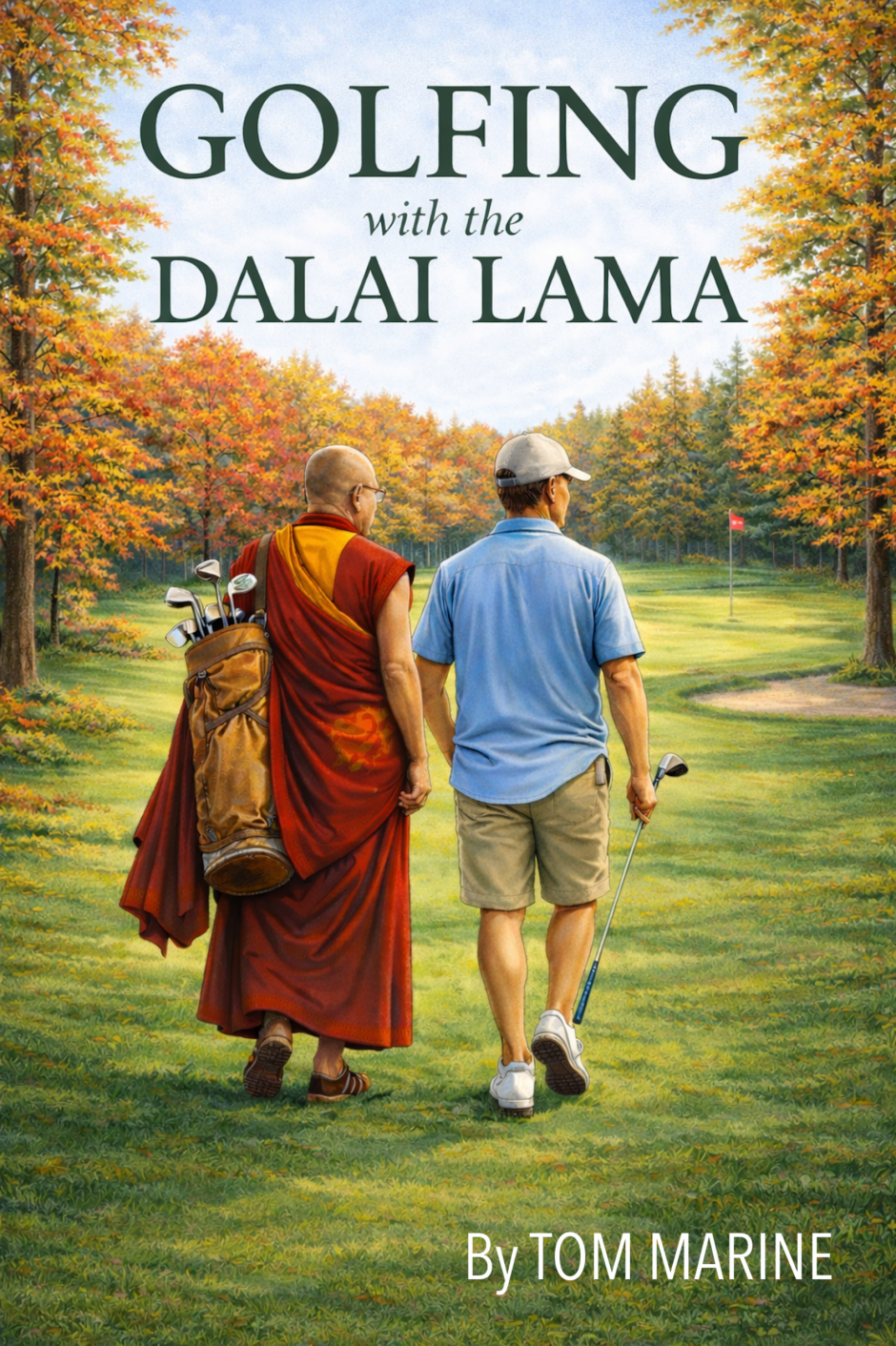
As this blog unfolds, it will be obvious that the Dalai Lama is not THE Dalai Lama, but someone who has the Dalai Lama qualities. He’s a combination of mythology, spirituality, religion, and a keen professor from Miami of Ohio, who we call the Dalai Lama.
We called him Dalai Lama for several reasons – he was bright, calm, loving, balanced, and he practiced his craft. He wasn’t someone to one person and someone else to another person – and, he could spot the fakes a mile away. But, his alignment was not to judge, but to focus on what he could do – many times ignoring what others would have trouble ignoring.
A Conversation Before the First Tee
(Preparing for “Golfing with the Dalai Lama” – what to expect, not an excerpt.)
By TOM MARINE
The sun had barely made it over the tree line when we arrived at the first tee.
Morning on a golf course has its own kind of quiet. Not silence exactly. The birds are usually already at work, and somewhere in the distance a groundskeeper is coaxing a mower across the dew. But it is a quieter version of the world, the kind of quiet that makes you feel as though you’ve arrived before the day officially begins.
I set my bag beside the tee marker and looked down the fairway.
It was one of those views that makes you momentarily believe you might actually play well today.
Beside me, the Dalai Lama stood with his hands folded behind his back, studying the course the way someone studies a painting.
“You know,” he said finally, “golf courses very optimistic places.”
I laughed. “Optimistic?”
“Yes. Every hole assumes best possible version of player.”
“That’s definitely not the version of me that usually shows up.”
He smiled.
“Still,” he said, “course gives you chance.”
I pulled my driver from the bag and gave it a couple of practice swings.
“That’s very kind of the course. But it clearly hasn’t seen my slice.”
The Dalai watched the club move through the air.
“You see?” he said. “Already talking about life.”
“I was talking about golf.”
“Same thing sometimes.”
“That’s what worries me.”
He grinned.
I looked down the fairway again. Eighteen holes stretched somewhere beyond what we could see from there. Some open. Some narrow. Some forgiving. Some designed by people who apparently had unresolved anger issues.
“So,” I said, “what’s on the agenda today?”
“Agenda?”
“You know. What are you going to teach me?”
He turned toward me.
“Why you assume I am teacher?”
I stared at him.
“You’re the Dalai Lama.”
“And you are Tom.”
“That doesn’t exactly balance the résumé.”
He laughed.
“Maybe not know teacher until lesson over.”
I lowered the driver.
“Okay. That sounded suspiciously profound.”
“Sounded profound to me too.”
And there it was.
One of the problems with playing golf with the Dalai Lama was that I was never completely sure when he was sharing ancient wisdom and when he was messing with me.
I teed up a ball.
“You know,” I said, “most people come out here to get away from thinking about life.”
“Good idea.”
“And yet every time we play, somehow we end up talking about it.”
“Also good idea.”
“You’re very hard to argue with.”
“No. You very good at arguing.”
“Thank you.”
“Was not compliment.”
I stepped away from the ball.
“See? This is what I mean. I ask a simple question and suddenly I’m defending my personality.”
“Could just hit ball.”
I looked at him.
“Now who’s being profound?”
He shrugged.
The sunlight had begun working its way across the fairway, burning away the last patches of morning mist. Somewhere ahead, another foursome laughed.
For a moment neither of us said anything.
Then the Dalai pointed toward my ball.
“You keep score today?”
“Of course.”
“Why?”
“Because it’s golf.”
He nodded.
“Only reason?”
I knew that tone.
“Here we go.”
“Where?”
“Where you take something perfectly simple and make me question my entire existence.”
He laughed.
“Only asked about score.”
“Exactly.”
I rested the club against my shoulder.
“Yes, I keep score. I like knowing how I played.”
“Compared to?”
“Par.”
He waited.
“And how I usually play.”
He kept waiting.
“And sometimes how you play.”
“Ah.”
“There it is. I knew you were going somewhere.”
“Not going anywhere. Standing here.”
I shook my head.
“Fine. Yes. I like to win.”
“Bad?”
“No.”
“Good?”
“I’d say so.”
He looked down the fairway.
“Maybe.”
There are few things more irritating than someone responding to one of your certainties with maybe.
“So winning isn’t good?”
“Did not say that.”
“Losing is good?”
“Did not say that either.”
“Then what are you saying?”
“Maybe question not who wins.”
“What’s the question?”
He smiled.
“Long round.”
I stared at him.
“That’s it?”
“For now.”
I picked up my driver again.
“This is going to be one of those days, isn’t it?”
“Hope so.”
I took another practice swing.
“You know what I think?”
“Hmmm?”
“I think you enjoy making things complicated.”
“No. Things already complicated. People enjoy making simple.”
That stopped me.
Not because I agreed with him. At least not completely.
But because I knew enough about myself to recognize the accusation.
I liked answers.
Maybe that came from journalism. Ask the question. Gather the facts. Understand the issue. Explain it.
Maybe it came from consulting. Identify the problem. Develop the solution. Implement the plan.
Maybe it came from religion. Believe the right things. Follow the right path.
Maybe it simply came from being human.
Answers are comfortable.
Questions can follow you around.
I looked at him.
“So what happens when I’m sure I’m right?”
“Usually?”
“Yes.”
“Become harder to teach.”
“That sounds like something you’ve been waiting years to tell me.”
“Maybe.”
There was that word again.
I stepped behind the ball and looked toward the fairway.
“What else are we going to talk about?”
“Don’t know.”
“Come on. You have to have some idea.”
He thought for a moment.
“Golf.”
“Good.”
“Winning.”
“Apparently.”
“Losing.”
“Less interested.”
“Fear.”
“Wonderful.”
“Happiness.”
“Better.”
“Rules.”
“I know the rules.”
He smiled.
“Exactly.”
I narrowed my eyes.
“Religion?”
“Maybe.”
“Politics?”
He made a face.
“Hopefully not too much.”
“Something we agree on.”
“People we disagree with?”
“That could take eighteen holes.”
“Maybe more.”
I laughed.
He looked down the fairway again.
“Heroes.”
“Heroes?”
“Yes.”
“Why?”
“Everybody has.”
“I suppose.”
“And everybody is.”
I waited.
He said nothing more.
“That one needs explanation.”
“Maybe later.”
“Of course.”
I addressed the ball again.
Behind me, his voice came quietly.
“Maybe questions too.”
I backed away.
“What about questions?”
“Maybe spend too much life trying to answer.”
“That’s generally what questions are for.”
“Maybe some are for living.”
I looked at him.
He was watching the fairway, not me.
“So now we’re going to spend eighteen holes without answering anything?”
“No.”
“Good.”
“Probably answer many things.”
“Better.”
“Some answers probably wrong.”
“Whose?”
He turned toward me and smiled.
“Yes.”
I laughed.
“You know, I’m beginning to think this round might be less relaxing than advertised.”
“Golf never relaxing.”
“Now that I believe.”
He looked at the ball still sitting on my tee.
“Your honor?”
I stepped aside.
“Actually, I think it’s yours.”
The Dalai nodded, pulled his driver from the bag and replaced my ball with his.
He took one easy practice swing, settled over the ball and sent it sailing down the middle of the fairway. Not spectacular. Not showy. Just one of those irritatingly effortless shots that seemed to know exactly where it belonged.
We watched it land in the short grass and roll a few yards before stopping comfortably in the center of the fairway.
I looked at him.
“You know, philosophy is probably a lot easier from the middle of the fairway.”
He bent down and picked up his tee.
“Maybe.”
“Would you please stop saying that?”
He thought for a moment.
“Maybe.”
I shook my head and put my ball back on the tee.
For a moment, I could feel the stillness of the morning—the kind that exists just before something begins.
Maybe that’s part of golf’s appeal.
Every round starts clean.
Whatever happened yesterday doesn’t count. Whatever you shot last week doesn’t matter. The scorecard has eighteen empty boxes, and for one brief moment on the first tee, every possibility remains available.
Even the impossible ones.
I wagged the club.
“Ready?”
The Dalai folded his hands.
“Always.”
I swung.
The ball leapt from the clubface and climbed beautifully into the morning light.
For perhaps two seconds, I thought I had hit exactly the shot I intended.
Then it began drifting right.
And kept drifting.
We watched it disappear toward the trees.
I sighed.
“Well,” I said, picking up my bag, “at least I know what I need to fix.”
The Dalai started down the fairway.
“Maybe.”
I followed him.
“Maybe? You just watched me slice it into the trees.”
“Yes.”
“So what else needs fixing?”
He kept walking.
“Long round, Tom.”
“That isn’t an answer.”
“No.”
I caught up with him.
“Then what is it?”
He looked ahead toward where my ball had disappeared, then beyond it—to his ball sitting safely in the fairway, the trees beyond, and eighteen holes we hadn’t played yet.
“Beginning.”
And we walked toward my ball.