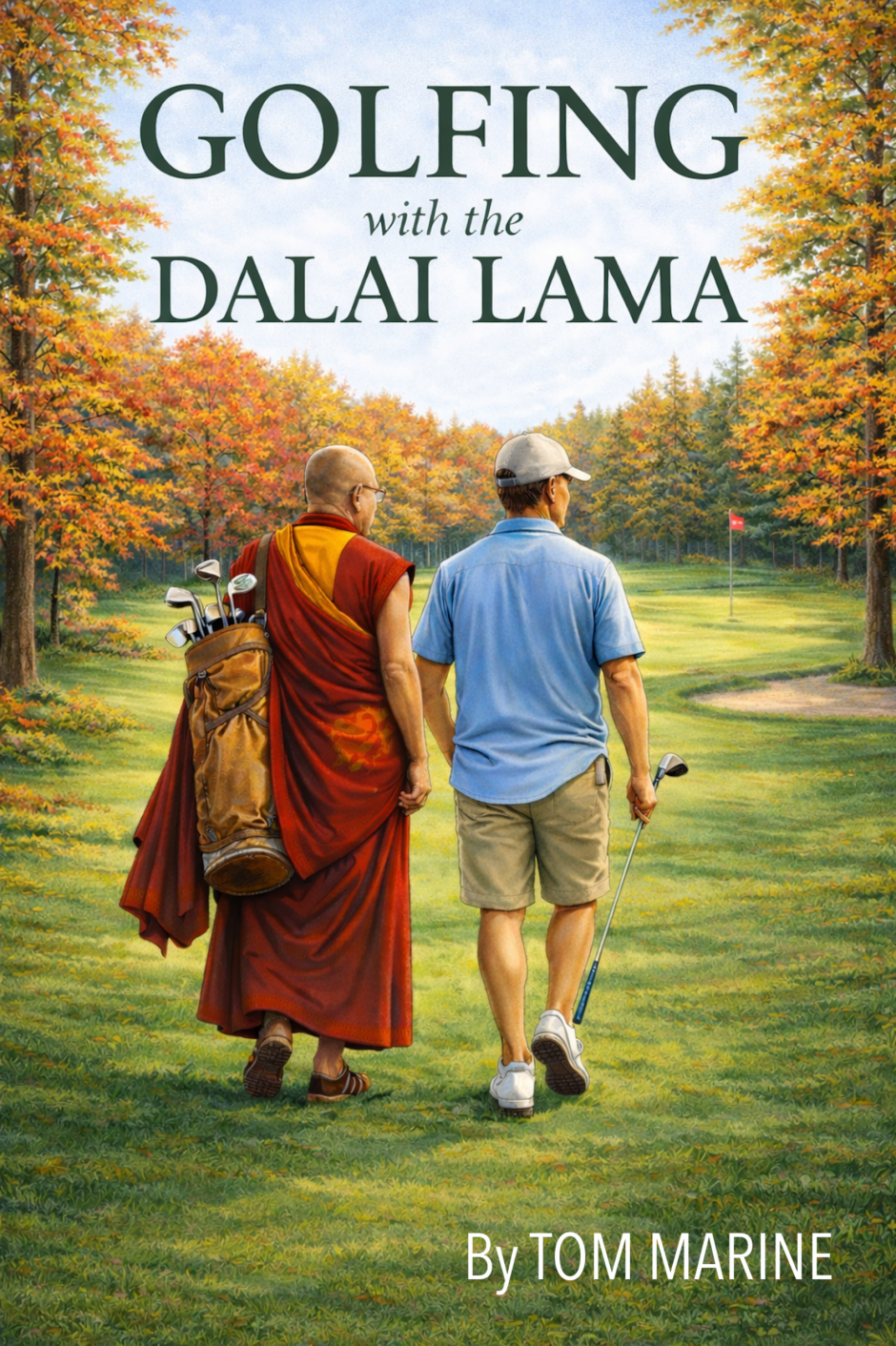

As this blog unfolds, it will be obvious that the Dalai Lama is not THE Dalai Lama, but someone who has the Dalai Lama qualities. He’s a combination of mythology, spirituality, religion, and a keen professor from Miami of Ohio, who we call the Dalai Lama.
We called him Dalai Lama for several reasons – he was bright, calm, loving, balanced, and he practiced his craft. He wasn’t someone to one person and someone else to another person – and, he could spot the fakes a mile away. But, his alignment was not to judge, but to focus on what he could do – many times ignoring what others would have trouble ignoring.
A Conversation Before the First Tee
(Preparing for “Golfing with the Dalai Lama” – what to expect, not an excerpt.)
By TOM MARINE
The sun had barely made it over the tree line when we arrived at the first tee.
Morning on a golf course has its own kind of quiet. Not silence exactly. The birds are usually already at work, and somewhere in the distance a groundskeeper is coaxing a mower across the dew. But it is a quieter version of the world, the kind of quiet that makes you feel like you’ve arrived before the day officially begins.
I set my bag down beside the tee marker and looked down the fairway.
It was one of those views that makes you momentarily believe you might actually play well today.
Beside me, the Dalai Lama stood with his hands folded behind his back, studying the course the way someone studies a painting.
“You know,” he said finally, “golf courses are very optimistic places.”
I laughed. “Optimistic?”
“Yes. Every hole assumes the best possible version of the player.”
“That’s definitely not the version of me that usually shows up,” I said.
He smiled.
“Still,” he said, “the course always believes in you.”
I pulled my driver from the bag and gave it a couple of practice swings.
“That’s very kind of the course,” I said. “But it clearly hasn’t seen my slice.”
The Dalai watched the club move through the air and nodded thoughtfully.
“You see?” he said. “Already we are talking about life.”
“How do you figure?”
“In golf,” he said, “we are always trying to correct something. A swing. A grip. A stance. But the course is patient. It gives us another hole, and another, and another.”
He paused and looked down the fairway again.
“Life is very much the same.”
I rested the club against my shoulder.
“That’s easy for you to say,” I said. “You don’t have to keep score.”
He chuckled at that.
“Oh, Tom,” he said. “Everyone keeps score.”
He gestured toward the rising sun.
“Some people keep score with money. Some with achievements. Some with reputation.”
“And some with birdies?” I asked.
“Yes,” he said. “But the interesting question is not how we keep score.”
“What’s the interesting question?”
He turned toward me.
“Whether we are keeping the right score.”
I looked down the fairway again.
“That sounds like the kind of question that could ruin a perfectly good round of golf.”
“Or improve it,” he said.
I teed up the ball.
We stood there for a moment watching the sunlight slowly spill across the fairway. The dew was beginning to disappear, and the quiet of the course was starting to shift into the early movements of the day.
A foursome somewhere behind us on a turn hole laughed loudly enough that it carried across the trees.
I wagged the club once and then paused.
“You know,” I said, “most people come out here to get away from thinking about life.”
“That is true.”
“And you’re suggesting we spend the next four hours thinking about it?”
“Not exactly.”
He bent down and picked up a small twig from the grass.
“You see this?”
“Looks like a twig.”
He nodded.
“If we walked this course and only talked about life, we would miss the golf. And if we walked this course and only talked about golf, we would miss life.”
He snapped the twig in half and tossed it aside.
“The trick is to notice both.”
I considered that for a moment.
“So, what you’re saying,” I said, “is that somewhere between my terrible swing and the beauty of this morning there’s supposed to be some kind of lesson.”
He smiled.
“There are always lessons.”
“That sounds like a lot of pressure.”
“Only if you are trying to pass the test.”
I took a practice swing.
The club cut through the morning air with a satisfying whoosh.
“Let me ask you something,” I said.
“Yes?”
“Are we going to spend the whole round talking about life lessons?”
The Dalai tilted his head slightly and considered the question.
“No,” he said.
“That’s good.”
“We will also talk about suffering.”
I stopped mid-swing.
“Suffering?”
“Yes,” he said calmly. “Golf provides many opportunities for suffering.”
“Well, that part I’m already familiar with.”
He laughed.
“But do not worry,” he said. “Golf also provides opportunities for joy.”
“That part I’m still working on.”
He pointed toward the ball on the tee.
“Perhaps today we practice both.”
“Joy and suffering?”
“Yes.”
“That sounds suspiciously like golf.”
He nodded approvingly.
“Exactly.”
I stepped up to the ball.
For a moment I could feel the quiet of the morning again—the kind of stillness that seems to exist just before something begins.
Behind me, the Dalai spoke again.
“You know, Tom, we have spent many mornings working on your golf swing.”
“That’s true.”
“And I have enjoyed it very much.”
“Mostly because it gives you something to laugh at.”
“That also is true.”
I turned and looked at him.
“So, what’s different about today?”
He looked around the course, taking in the trees, the light, the long stretch of fairway ahead of us.
“Today,” he said gently, “we may also work on your life.”
I stared at him.
“That seems like a much bigger project.”
“Yes,” he agreed. “But the good news is that the same principles apply.”
“And what principles are those?”
He smiled.
“Patience. Curiosity. Forgiveness.”
He nodded toward the ball.
“And occasionally a good follow-through.”
I shook my head.
“You know, I’m starting to suspect you’ve been using golf as a disguise for philosophy.”
“And I am starting to suspect,” he replied, “that you have been using philosophy as an excuse for bad golf.”
“That’s unfair.”
“Is it?”
I lined up the shot.
“Just remember,” he said quietly behind me, “every round begins with a single swing.”
“That sounds suspiciously like something you’ve said before.”
“Perhaps,” he said. “But today you might hear it differently.”
I took the club back.
“Ready?” I asked.
The Dalai folded his hands and nodded.
“Always.”
I swung.
The ball leapt off the club face and sailed out into the morning light.
For a few hopeful seconds we both watched it fly.
Then it began drifting gently to the right.
The Dalai sighed.
“Ah,” he said.
“Suffering?”
“Yes.”
He smiled.
“But we still have seventeen holes.”